
Persian Spinach and Yogurt Dip
Adventures in Cooking My Cookbook Collection: Gil Marks' Olive Trees and Honey

This week’s recipe is just for paid subscribers to The Jewish Table. If you’ve found your way here but are not yet subscribed for the paid weekly newsletter, you can do that below. You will never miss a recipe or a story, and I’ll be eternally grateful for your support.

Happy mid-August (somehow)!
Today, we are cooking up a lovely Persian Spinach Dip from one of my favorite cookbooks: Olive Trees and Honey by Gil Marks.
Way back in 2021, I launched a newsletter column called Adventures in Cooking My Cookbook Collection, where I set out to chop, sauté, and braise my way through some of the 150+ Jewish cookbooks that crowd my bookshelves. (Scroll down for the archives.) It has been a minute, actually three whole years, since the last “semi-regular” column ran. But today’s book and recipe are the perfect duo to revive it.
Why? Because author Gil Marks, of blessed memory, is the official spiritual rebbe of this newsletter. Marks, who past away from cancer in 2014 at the tragically young age of 62, was a remarkable human. A “real one,” as the kids say. He was a scholar and a walking encyclopedia of Jewish food history—so much so that he wrote the literal Encyclopedia of Jewish Food. You may have noticed that I quote from that book all. the. time.
He was also an unimpeachable mensch who was thrilled to share his insights with anyone interested. I remember, early on in my career, heading to his Upper West Side apartment to borrow his copy of an out-of-print cookbook. I expected to be there for a few minutes tops, but stayed for over an hour as he regaled me with stories and historical tidbits.
Gil understood long before most American food writers, that Jewish cuisine is a mosaic made up of the rich cultural and culinary traditions of Jewish communities around the world. And his books, like his knowledge, pulled inspiration from across the globe.


In 2012, I interviewed Gil on stage at the 92Y. (The event listing is still online, 13 years later, which is kind of wild.) I don’t remember exact moments from the conversation, but I remember it being one of the more thrilling and terrifying moments of my career up to that point. Gil had a way of wandering off topic when he spoke. He always found his way back to the point eventually, but not in any sort of linear fashion. Keeping the conversation flowing in a way that held the audience’s attention felt a bit like lassoing a tornado. But it was the honor of a lifetime to try.
I try to carry forward his legacy of diligence, curiosity, and commitment to finding the story, not just the soundbite, behind the food.
I so miss having Gil around as a friend and resource. But there is a part of me that is grateful someone of his extraordinary caliber did not have to watch the food media world (and media in general) get so woefully diluted by social media and influencer culture, and whatever the heck AI is currently doing to destroy journalistic integrity. In the face of today’s media landscape, I try to carry forward his legacy of diligence, curiosity, and commitment to finding the story, not just the soundbite, behind the food.
More than any other Jewish food hero of mine, Gil’s wisdom continues to guide my work and inspire me even a decade after his passing. And his books, particularly the Encyclopedia of Jewish Food and Olive Trees and Honey, remain invaluable resources for me as a journalist, a recipe developer, and a home cook.
This week, I am sharing Gil’s recipe for Persian Spinach Dip (borani esfanaj) from Olive Trees and Honey. Published in 2005, the book highlights a collection of vegetarian recipes that Jewish communities have cooked and served throughout history—everything from Ashkenazic Stewed Carrots (mehren tzimmes) and Hungarian Potato Dumplings (shlishkes) to Syrian Chickpea Turnovers (sambusak) and Tunisian Braised Chard (silka).
And because it’s Gil, each recipe is accompanied by a miniature essay, rich with history and context. As he writes for the spinach dip:
No Persian dairy meal would be complete without a borani, a yogurt and vegetable dish that is common in Persian cooking and particularly refreshing in hot weather. The name derives from the first woman to rule Persia thirteen hundred years ago: a queen named Poorandikht (or Pouran), who supposedly had a particular fondness for yogurt. Over the centuries, the pronunciation of pooran evolved into boran. Spinach, eggplant, and cucumber are the three favorite types of borani. In this version, the currylike spices complement the tangy yogurt and the slightly bitter, earthy spinach.”
I couldn’t have written it better myself. Thank you, Gil, for your friendship, your legacy, and the continual inspiration.


From The Jewish Table Archives: Adventures in Cooking My Cookbook Collection
Check out the Adventures in Cooking My Cookbook Collection archives for some historical and contemporary recipes from the wonderful Jewish cookbooks on my bookshelf.
Creamy Spinach Soup from Oma & Bella by Alexa Karolinski
Green Minestrone with Chicken from The Whole World Loves Chicken Soup by Mimi Sheraton
Onion-Sour Cream Tart from The Molly Goldberg Jewish Cookbook by Gertrude Berg and Myra Waldo
Moroccan Carrot Salad with Meyer Lemon Yogurt from Bavel by Ori Menashe and Genevieve Gergis
Winter Squash with Caramelized Onions from Quiches, Kugels, and Couscous by Joan Nathan
Date Shake with Toasted Nuts from The New Persian Kitchen by Louisa Shafia
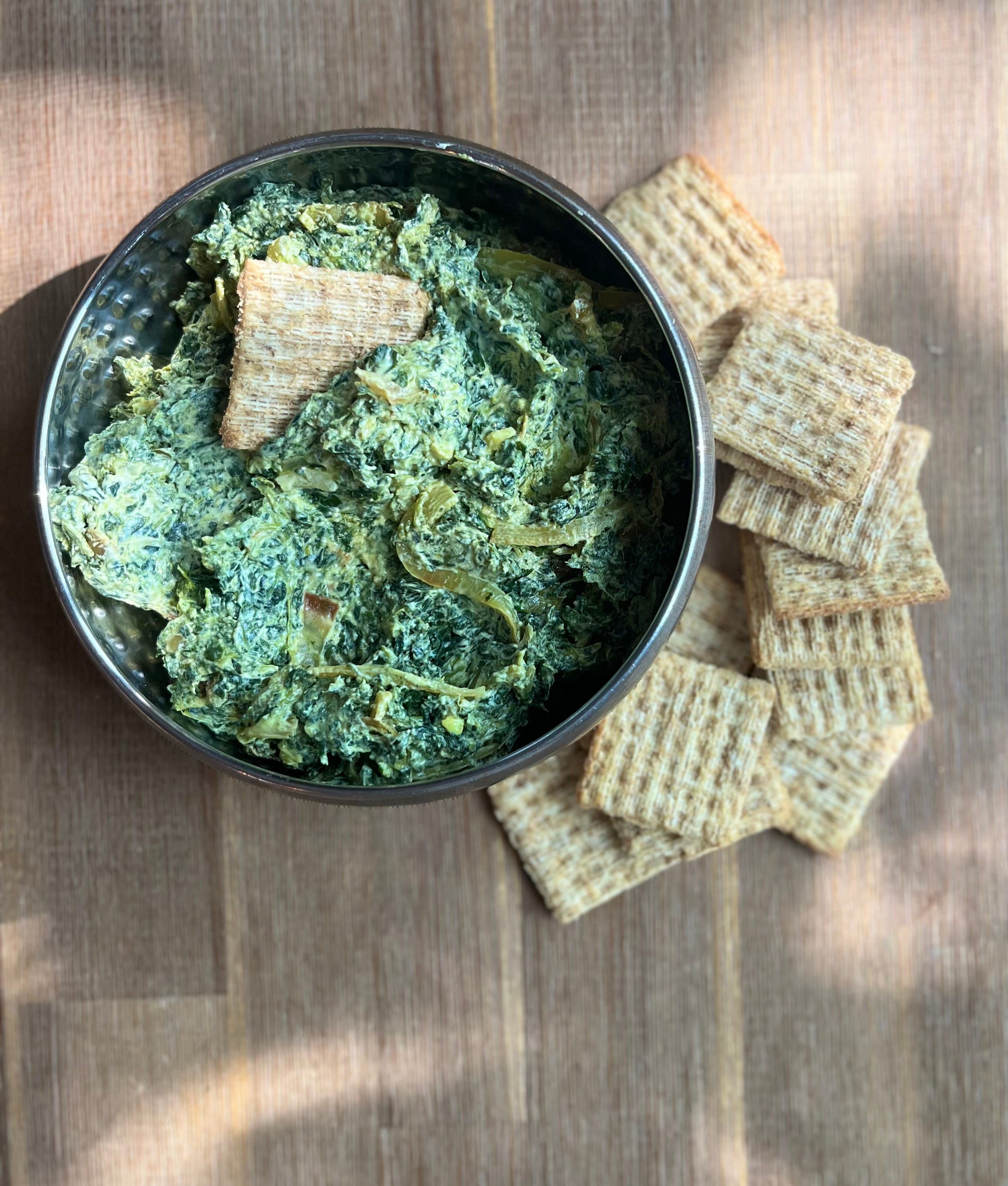
Persian Spinach Dip (Borani Esfanaj)
Serve this creamy, textured, beautifully spiced spinach and yogurt dip with veggies, crackers, or toasted pita for dipping.
The recipe is adapted from Olive Trees and Honey: A Treasury of Vegetarian Recipes from Jewish Communities Around the World, by Gil Marks.
Serves 4 to 6
